
Alexander of Macedon, a historical biography
| série: | Alexandre le Grand |
| éditeur: | California Press |
| auteur: | Green Peter |
| classement: | biblio506 |
| année: | 1991 |
| format: | cartonné, avec jaquette |
| état: | TBE/N |
| valeur: | 20 € |
| critère: | *** |
| remarques: | English book Alexander of Macedon, 356-323 BC, a historical biography see also the other well illustrated book of Peter Green about Alexander preface - raised edition of the 1976 first book with additional comments of Don Engels (Alexander's logistics, >> see this book) who was a scholar of Peter Green, a Cambridge-educated historical novelist, additional advise also given by Ernest Badian, doyen of the researches in this field and by the Association of the American Ancient historians 1/ Philip of Macedon - genius remains to a surprising extent the product of its environment, what Alexander was, Philip and Macedonia in great part made him, at Alexander's birth, two further good news reached Philip at the same time: "victory of Parmenio and victory at the Olympic Games" - description of Macedonia, originally three kingdoms: Elimiotis, Orestis and Lyncestis, Macedonia's forests provided wood for the shipbuilding, but at the beginning Macedonia had no fleet Alexander I was the first king to reorganize Macedonia as a state and to create a regular army, - for the Greek city-states, Macedonia has always been a bufferstate from the Barbarians, - alliance with Thebes - the power of the king was nearly absolute in contrast with Greek democratic states - at the age of 23, Philip won a great battle over the Illyrians - first marriage with Audata of Illyria who died very early leaving a daughter: Cynna or Cynane - second marriage with Phila, a princess of Elimiotis who also died very early leaving no children - then Philip acquired as a mistress Philinna of Larissa with whom he had a son: Arrhidaeus - third marriage with Olympias of Epirus - so far Philip had been a good strategist and diplomat, however neither Philip or Alexander were natural economists - source of income was Mt. Pangaeus and its gold mines that enabled Philip to consolidate his army and bribe foreign politicians, he showed always great admiration for Athens - it was the triumph of authoritarian efficiency over incompetent and corrupt idealism 2/ the gardens of Midas - Aristander of Telmessus, seer of Alexander, interpreted his dreams, Alexander generally represented as a precocious "enfant terrible", Alexander never forgot, seldom forgave >> p. 39 description of Philip's court - first teacher: Leonidas (physical endurance) - second teacher: Lysimachus of Acarnania, Alexander was taught music, reading (Homer) and writing >> p. 46 success in diplomacy with Athens by Philip "the Delphi affair" (sacred war) - second mistress of Philip: Nicesipolis of Pherae called the Thessalian witch whose daughter Thessalonice married Cassander - idea of the Panhellenic crusade against Persia raised by Isocrates - third teacher: Aristotle, school of Mieza = part of the gardens of Midas >> p. 57 notes on Alexander's ambition when he wrote to Aristotle "in what shall I surpass other men if those doctrines wherein I have been trained are to be all men's common property" - Aristotle favoured republicanism, however he allowed one justification for monarchy: if the outstanding personal achievements would outclass the achievement of all the citizens put together, furthermore Aristotle was a racist (xenophobia) - fourth marriage of Philip with Meda, daughter of the Thracian prince Cothelas, no children - while Philip is in war against Byzantium and Perinthus, he appoints Alexander as regent of Macedonia with Antipater to assist him 3/ from a view to a death - Greece threatened now Macedonia with the alliance with Artaxerxes, war in the Black Sea to the disadvantage of Philip - first error of Athens (implemented by Demosthenes) to accept a battle on land with Philip instead of using their navy to attack Macedonia in the north - 338 BC battle of Chaeronea >> p. 74-76 excellent description of the battle >> p. 77 the story with Demades (Philip had the ability to shrug off his drunkenness at once when it was necessary) - Philip granted favourable peace terms to Athens, receiving even the Athenian citizenship, Thebes was not treated as favourably - creation of the Corinthe's ligue, Philip becomes "hegemon" (leader) and strategos autokrator (commander-in-chief), peace was agreed but Greek's resentment towards Macedonia continued - fifth marriage of Philip with Cleopatra, niece of Attalus, repudiation of Olympias and Alexander and encouraging rumours that Alexander, although first-born son, could be illegitimate >> in fact most curious view in Philip's decision unless Philip would have thought that Alexander and Olympias were engaged in a plot against him, it can however be assumed that Alexander had urgent motives for wishing Philip out of the way by staging a coup before the Persian expedition - "sacred war" on Persia was declared and all Greek serving with the Great King considered as traitors (15'000 mercenaries), Parmenio's campaign in Asia Minor - Cleopatra gives birth to an heir but unfortunately for Philip to a girl named Europa, this induces Philip to recall Alexander (Demaratus' mission), Philip also decides to marry his daughter Cleopatra to Alexander of Epirus to strengthen his position >> p. 99 the affair with Pixodarus' daughter - later on, Cleopatra gives birth to a male heir: Caranus but Philip is murdered by Pausanias with the hand of Olympias not far away, Alexander could also have been involved with Pausanias' plot but nothing is assumed 4/ the keys of the kingdom - shortly after Alexander's taking over, the most active hostility came from Athens and on the other side, Parmenio was already involved with Attalus in a possible rebellion against Alexander, however Alexander reacted with the utmost celerity and audacity >> p. 120 comments about the reasons of Alexander's hostility towards Parmenio - well-organized campaign against the Triballians and Thracians - mention of the "pothos" of Alexander = longing for things not yet within reach and for the unknown - in the war against Glaucias, leader of the Taulautians and Cleitos, king of Illyria, Alexander showed one of his most eccentrically brilliant stratagems >> p. 125 one of the qualities which most clearly distinguished Alexander from the common run of competent field-commanders was his almost uncanny ability to divine enemy tactics in advance - now Alexander could turn his war efforts to Thebes by destroying utterly this city but it was one of Alexander's greatest errors because revenge took place in the Greek cities 5/ the captain-general - preparation and organisation of the expeditionary force, Parmenio becomes second-in-command but only because no other one could have taken his position at this stage, Parmenio then indispensable? - Alexander refuses to marry and beget an heir before his Asian expedition which was to cause bloodshed and chaos after his death >> p. 155/156 the financial problems of Alexander (he had to borrow money from his friends to finance the expedition) - start of the Panhellenic crusade with 43'000 infantry (hereof 7000 Greek soldiers) and 6000 cavalry (hereof 600 Greek) as well as 160 ships but Athen's contribution was only of 20 triremes and 200 cavalry, however Greek troops were mostly used as hostages and in addition to the front-line troopes were: - sappers and siege-engineers (also responsible for the construction of road and bridges) - surveying section (= bematistae) - staff administration - scientists and historians - in comparison, Darius had about 50'000 Greek mercenaries at his disposal - critics of Callisthenes, a man of principle and a good historian but not always of common sense and somehow self-conceit - after having crossed the Hellespont (334), Alexander found his opponents at the Granicus (led by Arsites, Arsamenes, Spithridates and Memnon) - Arsites knew that the Macedonian infantry was superior to the Persian one, therefore he engaged his cavalry first with the Greek mercenaries behind - comments on the battle of Granicos which seemed, not to have been fought in the late afternoon of the first day (according to Arrian) but on the following day at dawn (according to Diodorus) >> p. 175-179 very detailed description of the battle with a good understanding (see also last chapter of the book) 6/ the road to Issus - problems with the Greek cities in Asia Minor (liberation policy) - difficult siege of Halicarnassus, death of Memnon >> p. 222 ambiguous story about Harpalus (possibly on a secret mission) >> p. 228-234 very good description again of the battle of Issus, the Persian infantry being still useless against the Macedonian phalanx, however the strong Persian cavalry caused some problems to Alexander and with the escape of Darius, the war was not over 7/ intimations of immortality - Alexander accused of forgery for the peace offer made by Darius: substituting a forged one to the original (without the territorial concessions made by Darius) - siege of Tyre, the longest and most gruelling military operation of Alexander's entire career >> p. 255-260 good description of the siege of Tyre n.b. today the causeway between Tyre and the mainland can still be observed - Gaza was still another problem that Alexander mastered equally, nothing more was on his way to Egypt which marked a psychological turning-point in his life, there he found a wholly acceptable context for his royal divinity >> p. 290-295 description of the battle of Gaugamela, Alexander's military masterpiece 8/ Lord of Asia - since Gaugamela, relations between Alexander and the Macedonian army deteriorated - Alexander makes acquaintance with the Chaldaean priests to whom he would show a genuine respect - 50'000 talents and other various treasures were found at Susa but Alexander's personal ambitions would reach farther than mere loot - 330 BC Alexander entered Persepolis, burial-place of the Achaemenid kings and also religious capital of the Empire (= holy city similar to Mecca or Jerusalem) where some great treasures were found again (120'000 talents representing the national income of Athens for 300 years) >> p. 314-316 description of Persepolis and Ecbatana - during his long stay at Persepolis, Green presumes that Alexander was waiting for the Persian New Year Festival to be acclaimed as Ahura Mazda's representative on earth, when this did not materialize, as a revenge, Alexander may well have decided to destroy Persepolis - Parmenio at this time was no longer chief of staff, now began Alexander's time of tragedy, since then he assumed sole command of the army and the immense treasures at his disposal left him free to indulge his fantasies as he chose - Bessus takes over as Ataxerxes IV, Alexander was now penetrating unknown territories and confronted with nationalist wars - death of Parmenio and Philotas, manipulation in the Philotas' affair 9/ the quest for the Ocean - guerilla war against Spitamenes, execution of Bessus - the murder of Cleitus marks the end of the freedom aura, fight with Oxyartes and marriage with Roxane - campaign of India which was much unknown at this time, with about 100'000 soldiers mixed with Iranian ones, meeting with Sisicottus and Taxila - battle with Porus = one of the best strategical battles of Alexander but real defeat with his soldiers who refused to continue the campaign any further, erection of 12 great altars to commemorate where Alexander stopped 10/ how many miles to Babylon >> p. 414/415 defection of Harpalus, set-up of the flotilla for the departure down-river the Jhelum towards the ocean - during a fight with the Mali, Alexander is heavily hurt, for one week between life and death and Alexander never fully recovered from this wound -meeting with Indian naked philosophers (gymnosophistae) for whom Alexander showed admiration but Alexander's conduct was always the exact opposite of what he then professed to admire - march through Gedrosia (Makran = a survival of the fittest - Alexander becomes increasingly paranoiac, suspicious and megalomaniac - mutiny of Opis which was psychologically well mastered by Alexander - Antipater who was to be replaced by Craterus refuses to join Alexander and has his son Cassander sent instead for negotiations >> p. 461 turmoil in Greece about the Harpalus' affair >> p. 467 death of Hephaestion - chaos after Alexander's death is beginning to take shape - possibility of Alexander's having been poisoned (as for Hephaestion) by some conspirators (with strychine? p. 476), in any case, alcoholism combined with the terrible wound Alexander had sustained in India would have lowered his resistance in case of sickness 11/ final comments about Alexander - short review of his various writers and of the biographics on Alexander >> p. 478 Alexander's history from hellenistic times up to now >> p. 482 - Droysen's study = first book of modern historical scholarship on Alexander, - Tarn's biography (first published in the Cambridge Ancient history), Tarn made the most popular version which was put forward as a humanist's work (goodness of human nature) - for Green, Alexander was a field-commander, possibly the best general the world has ever seen, but he was also keen on political maters >> p. 487 see this description - however Alexander spent also his life in the pursuit of personal glory (pothos) and the empire he built collapsed the moment he was gone, yet his legend still lives 12/ Appendix >> p. 489-512 propaganda at the Granicus - first battle and one of the most dramatic - comments on time, place and tactics - battle instead of scorched-earth policy as proposed by Memnon - Persian cavalry in front of the infantry - start of the battle in the late afternoon and continuation on the next morning it seems that two separate battles took place - only one (late afternoon attack in the river Granicus) according to Arrian and Plutarch - a second one next morning (dawn attack on the other side of the Granicus) according to Diodorus - the reason for the first version was possibly to exhibit Alexander in the light of a Homeric hero, but this falsification of the record is suggestive only >> a very good book, well developed with many background details - the author is very eager to explain the hidden faces of Alexander's biography taking his sources from all the Ancien writers - written in a plain way and with concrete facts, trying to also elucidate some unclear events and/or actions as well as suspicious sources - besides for the first time, the economical problems and their repercussions are being commented and analyzed n.b. see also first book of Green (1971) on Alexander (with beautiful illustrations) enclosures - cover of the book - the Alexander mosaic, dating from circa 100 BC, is a Roman floor mosaic originally from the House of the Faun in Pompeii, derived from a Greek painting now lost but the mosaic has a size of 5,8 x 3,1 meters and consists of about 3 millions little stones of different colours, the original now preserved in the Naples National Archaeological Museum - map of the Persian empire with the royal highways |
| couvertures: | 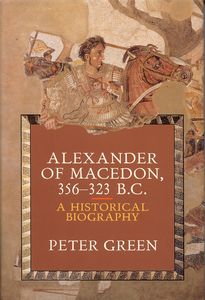 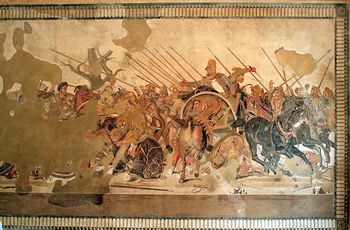 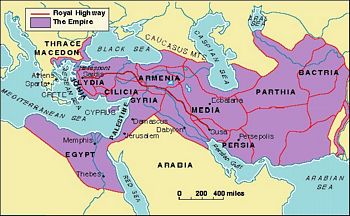 |
Copyright 2008 - 2026 G. Rudolf